Dead Heat Rules in Horse Racing: How Payouts Are Split
 Available in US
The first dead heat I experienced as a bettor was at Kempton on a midweek evening card. I had backed a horse at 9/2 that appeared to win by a nose on the big screen. Then the announcement came: dead heat for first. My payout was halved. Nine pounds fifty instead of nineteen pounds on a four-pound stake. I felt cheated for about thirty seconds, until I realised that the alternative — waiting for a photo finish that could have gone against me entirely — was worse. A half win beats a full loss every time. The full picture is in our guide to UK horse racing betting.
Dead heats are rare in horse racing but not as rare as you might think. With average Flat field sizes sitting at 8.90 runners in 2025, tight finishes are inevitable in competitive races, and the photo-finish technology, precise as it is, occasionally cannot separate two horses. When the judge declares a dead heat, a specific set of rules kicks in that affects every bet on the race — win bets, place bets, each-way bets, forecasts, and accumulators alike.
What Happens When a Dead Heat Is Declared
A dead heat occurs when the photo-finish image shows two (or very occasionally three) horses finishing in exactly the same position. The judge cannot separate them, so both are awarded the same finishing place. This is distinct from a photo finish where one horse is declared the winner after examination — in a dead heat, no separation is possible.
For betting purposes, dead heat rules apply: your stake is divided by the number of horses involved in the dead heat, and the remaining portion is settled at the full quoted odds. In a standard two-horse dead heat for first place, your stake is halved. If you backed one of the dead-heat winners at 6/1 for ten pounds, your settlement is: five pounds (half your stake) at 6/1 = thirty pounds return plus the five pounds stake portion = thirty-five pounds. Your other five pounds is a losing portion. Net return: thirty-five pounds from a ten-pound stake, compared with seventy pounds from a full win.
The logic is that in a dead heat, the two horses are sharing the prize of “first place”. Your bet covered one of them, and that horse occupies half of the available finishing position. The mathematics scales cleanly: in a three-way dead heat (extremely rare), your stake is divided by three. The principle remains constant regardless of how many horses are involved.
Dead Heats for Win Bets and Each-Way Bets
For a simple win bet, the dead heat calculation is as I described above: half your stake at full odds, plus the remaining half returned as a losing portion. The net effect is that you receive roughly half the return you would have collected from a clear win.
Each-way bets introduce additional complexity because dead heats can occur in the win position, in the place positions, or both. If your horse dead-heats for first, both the win and place parts of your each-way bet are affected by dead heat rules, because the horse is simultaneously sharing the win position and occupying a place position that is now contested.
More commonly, dead heats affect the place part of each-way bets. Imagine a race paying three places. Three horses finish very close, and the judge declares a dead heat for third between two of them. Your horse is one of them. Your place bet is now subject to dead heat rules: your place stake is halved, and the remaining half is settled at the place odds. The win part of your bet is lost (assuming the horse did not win), so you collect half your place return only.
This scenario is particularly frustrating because many punters do not anticipate dead heats in the place positions. In a race paying four places with a large field, a dead heat for fourth affects every each-way bet on both horses involved. The place dividends are reduced, and the each-way return that looked like a modest consolation prize becomes an even more modest one.
Dead Heats in Accumulators, Forecasts and Tricasts
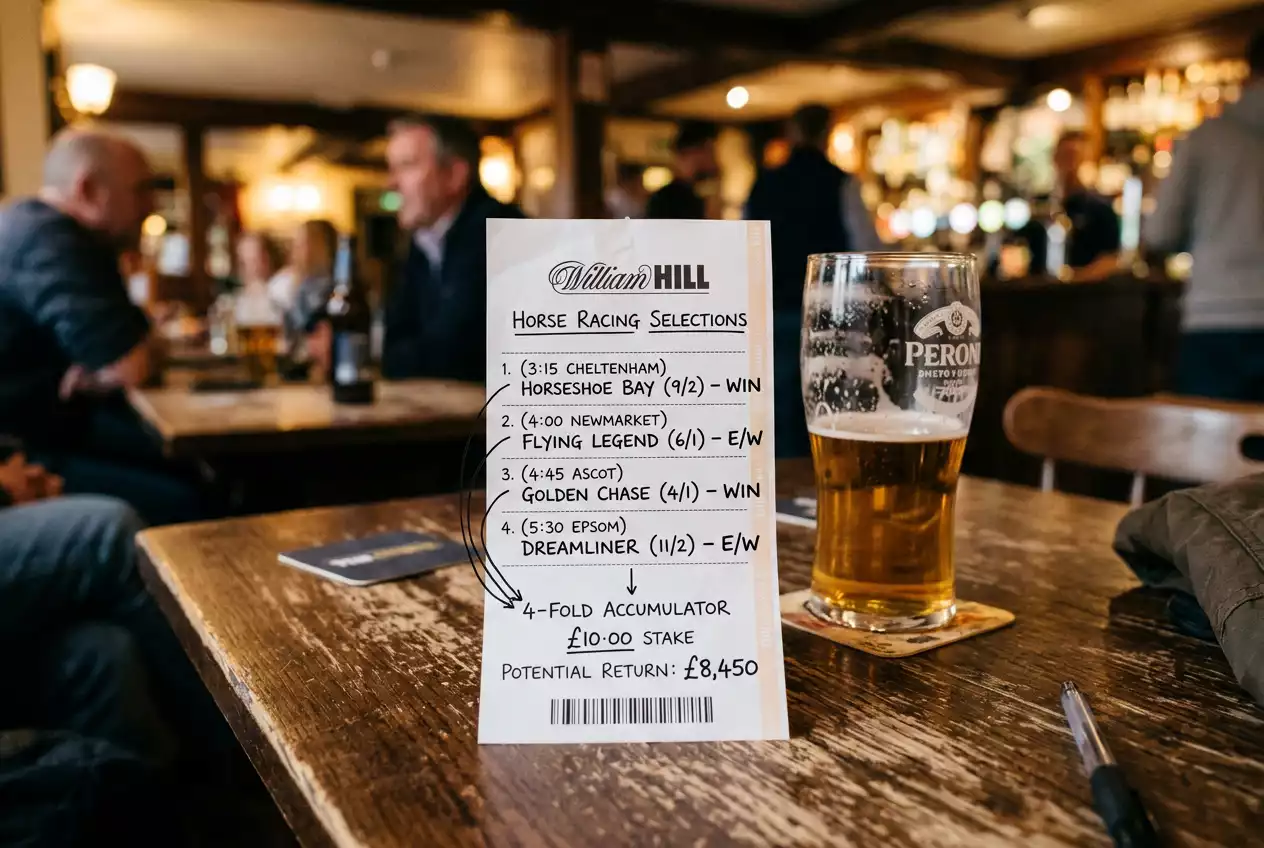
Dead heats in accumulators apply the reduction to the affected leg and then roll the reduced return forward into subsequent legs. If the first leg of your four-fold is a dead-heat winner, the halved return from leg one becomes the effective stake for leg two. This compounds through the remaining legs, meaning a dead heat on any leg of an accumulator roughly halves the entire accumulator’s final payout.
Forecast bets — where you predict first and second in the correct order — handle dead heats differently. If two horses dead-heat for first, any forecast combination involving either horse in first place is settled at half the full dividend. If you backed Horse A to beat Horse B in a forecast, and Horse A dead-heats for first with Horse C, your forecast is settled at half the declared dividend. If Horse A dead-heats with Horse B itself — the two horses you chose for first and second finish in a dead heat — the settlement depends on how many combinations of first and second the dead heat creates.
Tricast bets follow similar principles but with additional permutations. Dead heats in the first three positions create multiple possible finishing orders, and the tricast dividend is divided accordingly. These situations are complicated enough that I recommend checking the specific settlement with your operator if they arise — the combinations can be counter-intuitive.
How Often Dead Heats Happen and What to Expect
Dead heats are uncommon but not negligible. Across the thousands of races run in Britain each year, a handful produce dead heats for the win, and a larger number produce dead heats in the place positions (which are less publicised but equally relevant for each-way bettors). Jump racing sees fewer dead heats than Flat racing because the longer distances and obstacles tend to spread the field more at the finish. Sprint races on the Flat, particularly in large fields, are the most likely to produce dead heats because the margins between runners are finest.
Racecourse attendance in Britain reached 5.031 million in 2025, with many of those spectators experiencing dead heats in real time — the pause between the horses crossing the line and the judge’s announcement is one of the most tense moments in racing, and the collective groan when “dead heat” appears on the result board is unmistakable.
From a betting strategy perspective, dead heats are an unavoidable variance factor. You cannot predict them, and you cannot protect against them. What you can do is understand the settlement rules so that you know exactly what to expect when they occur. The worst outcome is being confused by a dead-heat settlement and wrongly believing you have been short-changed by the operator. The rules are standardised, transparent, and applied consistently — the payout may be disappointing, but it is always correct.
If you regularly bet each-way in large fields, dead heats in the place positions are something you will encounter several times a season. Accepting them as part of the variance — and factoring the possibility into your expected returns — is a sign of a mature betting approach. For a wider perspective on how race outcomes translate into returns across different bet structures, the full range of bet types provides the broader framework. The other settlement rule to know: Rule 4 deductions.
How is a dead heat settled for a win bet?
In a two-horse dead heat for first place, your stake is halved. Half is settled at the full quoted odds as a winning bet. The other half is treated as a losing bet. For example, a ten-pound bet at 6/1 in a dead heat returns thirty-five pounds (five pounds at 6/1 = thirty pounds plus five pounds stake), compared with seventy pounds for a clear win.
Can a dead heat affect my each-way bet on a placed horse?
Yes. Dead heats can occur in the place positions as well as for the win. If your horse dead-heats for the last qualifying place position, your place stake is halved and settled at the place odds. The win part of your bet is lost as normal. Dead heats in the place positions are more common than dead heats for first and affect each-way bettors more frequently.
Prepared by the Racing Horse Betting editorial staff.