Horse Racing Odds Explained: Fractional, Decimal and Starting Price
 Available in US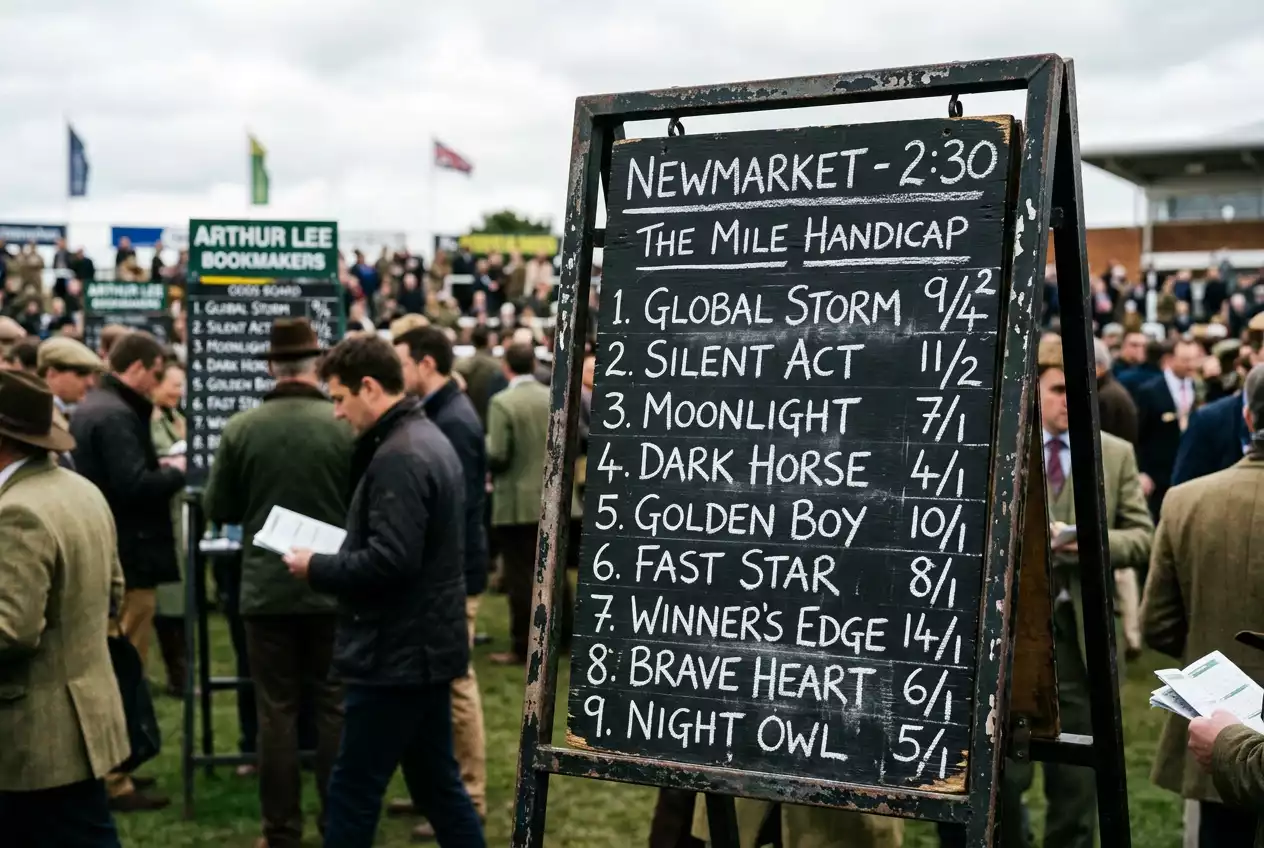
The first time I tried to explain fractional odds to a friend from Germany, he stared at me like I was describing a particularly obscure branch of medieval mathematics. “Why not just use a number?” he asked. Fair question. The UK’s horse racing market sits within an industry worth £3.7 billion in 2026, and much of that money flows through a pricing system that most Europeans find unnecessarily complicated. He was used to decimals; British racing was built on fractions. Both do the same job — they tell you how much you stand to gain relative to your stake — but the way they express that information shapes how punters think about value, risk, and timing. The full picture is in our guide to UK horse racing betting.
This guide walks through every odds format you will encounter in UK horse racing: fractional, decimal, and starting price. More importantly, it explains the mechanics underneath — how bookmakers build their margin into the odds, how prices move through the morning and into the afternoon, and how you can use that knowledge to make sharper decisions about when and where to bet. If you have ever wondered why two bookmakers show different prices on the same horse or what that “SP” checkbox actually means, this is where those answers live.
Table of Contents
Fractional Odds: The Traditional UK Format
I grew up reading the racing pages in the back of my father’s newspaper, and every price was a fraction. 5/1 meant five pounds profit for every one pound staked. 100/30 — which nobody under forty uses any more — meant a hundred pounds for every thirty, or ten to three if you simplified it. This notation is as deeply embedded in British racing culture as the parade ring and the judge’s chair, and it isn’t going anywhere despite decades of pressure from the decimal world.
The format is straightforward once you internalise the logic. The number on the left (the numerator) is your potential profit. The number on the right (the denominator) is the stake you need to risk for that profit. At 7/2, you profit seven for every two you stake. At 11/4, you profit eleven for every four. Your total return always includes your stake on top, so a winning £10 bet at 7/2 returns £45 — that is £35 profit plus the £10 stake.
Where fractions become genuinely useful is in quickly ranking horses by the market’s opinion of their chances. The shorter the fraction, the more likely the horse is expected to win. Evens (1/1) implies roughly a 50% chance. 2/1 implies roughly a 33% chance. 10/1 implies roughly a 9% chance. I say “roughly” because these implied probabilities don’t account for the bookmaker’s margin — more on that in the overround section below — but they give you a reliable ordinal ranking of the market’s view.
Odds-on prices — where the numerator is smaller than the denominator — cause the most confusion. At 4/6, you risk six to win four. Your total return on a £6 stake is £10, giving you £4 profit. Odds-on horses are the shortest-priced runners in the market, typically strong favourites. The key thing to remember is that you always get your stake back on top of the profit, so even a 1/5 favourite still returns £1.20 for every £1 staked. The profit is small, but it is positive. Odds-on prices crop up most often in small-field Group 1 races on the Flat and in novice hurdles during the National Hunt season where one horse dramatically outclasses the field.
Some fractional prices are more common than others. British bookmakers tend to use a standard ladder: 1/5, 2/9, 1/4, 2/7, 1/3, 4/11, 2/5, 4/9, 1/2, 4/7, 8/13, 4/6, 8/11, 4/5, 5/6, Evens, 6/5, 5/4, 11/8, 6/4, 13/8, 7/4, 15/8, 2/1, 9/4, 5/2, 11/4, 3/1, 100/30, 7/2, 4/1, 9/2, 5/1, 11/2, 6/1, 13/2, 7/1, 15/2, 8/1, 9/1, 10/1, and then in wider increments beyond that. Prices like 3/2 or 7/3 exist but are rare in practice. Knowing the ladder helps you spot value: if a horse drifts from 5/2 to 3/1, that is a one-step move on the ladder, but if it drifts from 5/2 to 7/2, that is a two-step move — a bigger signal of market sentiment.
Decimal Odds: The European Standard
Decimal odds strip away the mental arithmetic. Where fractional odds separate profit from stake, decimals give you a single number that represents your total return per unit staked. An odds-on favourite at 4/6 fractional becomes 1.67 in decimal — stake £1, get back £1.67, of which £0.67 is profit. A 5/1 shot becomes 6.00 — stake £1, get back £6.00, of which £5.00 is profit. The conversion formula is simple: divide the numerator by the denominator and add 1. So 7/2 becomes (7 / 2) + 1 = 4.50.
Most online bookmakers now let you toggle between fractional and decimal display with a single click. The betting exchanges default to decimal, and if you spend any time on those platforms, decimal thinking becomes second nature. European and Australian markets use decimals exclusively, which is one reason why the format has gained ground in the UK over the past decade — international racing and cross-sport bettors simply prefer the clarity.
The practical advantage of decimals is in comparing prices across bookmakers. Is 11/4 at one firm better than 2.90 at another? In fractional land, you need to do the conversion: 11/4 = 3.75. Yes, it is better. In decimal land, you just compare two numbers. That speed matters when you are scanning markets in the fifteen minutes before a race and trying to secure the best available price. It also matters for accumulators: multiplying decimal odds across four legs is trivially easy, whereas multiplying fractions involves a degree of mental gymnastics most people avoid.
I still think in fractions when I’m at the track — old habits — but I work in decimals for any serious analysis. Margin calculations, implied probability, value identification: all of these are cleaner in decimal. If you are new to racing and wondering which format to learn first, start with decimals. You can always convert to fractions later. The other direction is harder.
Starting Price: How SP Is Determined on Course
Starting price — universally abbreviated to SP — is one of those concepts that sounds simple until you try to explain exactly how it is formed, at which point it becomes one of the most unusual pricing mechanisms in any financial market. The gross gambling yield from remote horse racing bets reached £766.7 million in 2024-25, and a substantial portion of those bets were settled at SP rather than at fixed early prices. It is the default settlement price for anyone who doesn’t take an early price, and understanding how it works gives you a meaningful edge in deciding when to commit.
SP is determined at the racecourse in the moments before the race starts. A panel of official SP reporters — employed by the Starting Price Regulatory Commission (SPRC) — observe the on-course betting market and record the prices being offered by on-course bookmakers in the betting ring. The SP is essentially a snapshot of the on-course market at the off. It reflects the balance of money and opinion among bettors and bookmakers physically present at the track.
The process has changed over the years. The rise of online betting has shifted the weight of money off-course, which means the on-course market that determines SP now represents a smaller share of total turnover than it once did. There have been criticisms that the SP can be manipulated by placing strategic bets in the relatively thin on-course market to move the price in a desired direction. The SPRC has oversight responsibilities to prevent this, but the tension between on-course price formation and off-course volume remains an active debate in the industry.
For the previous financial year — 2023-24 — remote gross gambling yield from horse racing was £771.1 million, broadly in line with the 2024-25 figure. That consistency masks an underlying shift: more money is flowing through fixed-price and exchange markets, and the proportion settled at SP has been gradually declining. But SP remains important because it serves as the benchmark against which fixed prices are measured, particularly through Best Odds Guaranteed promotions.
When should you take SP? The short answer is: when you have no opinion on whether the price will shorten or drift before the off. If you think the horse is likely to attract late support and the price will shorten, taking the early price locks in the bigger number. If you think the horse might drift — perhaps because the going has changed or a strong rival has been declared — waiting for SP could give you a better number. But “waiting for SP” means accepting uncertainty: you don’t know what the SP will be until the race starts. That uncertainty is the price you pay for flexibility.
Early Price vs Starting Price: When to Lock In
Nevin Truesdale, then CEO of The Jockey Club, mentioned in 2024 that some online betting revenues had fallen 20% from the previous year despite better field sizes. Part of that picture involves how punters interact with pricing — and the early-price-versus-SP decision is central to that interaction.
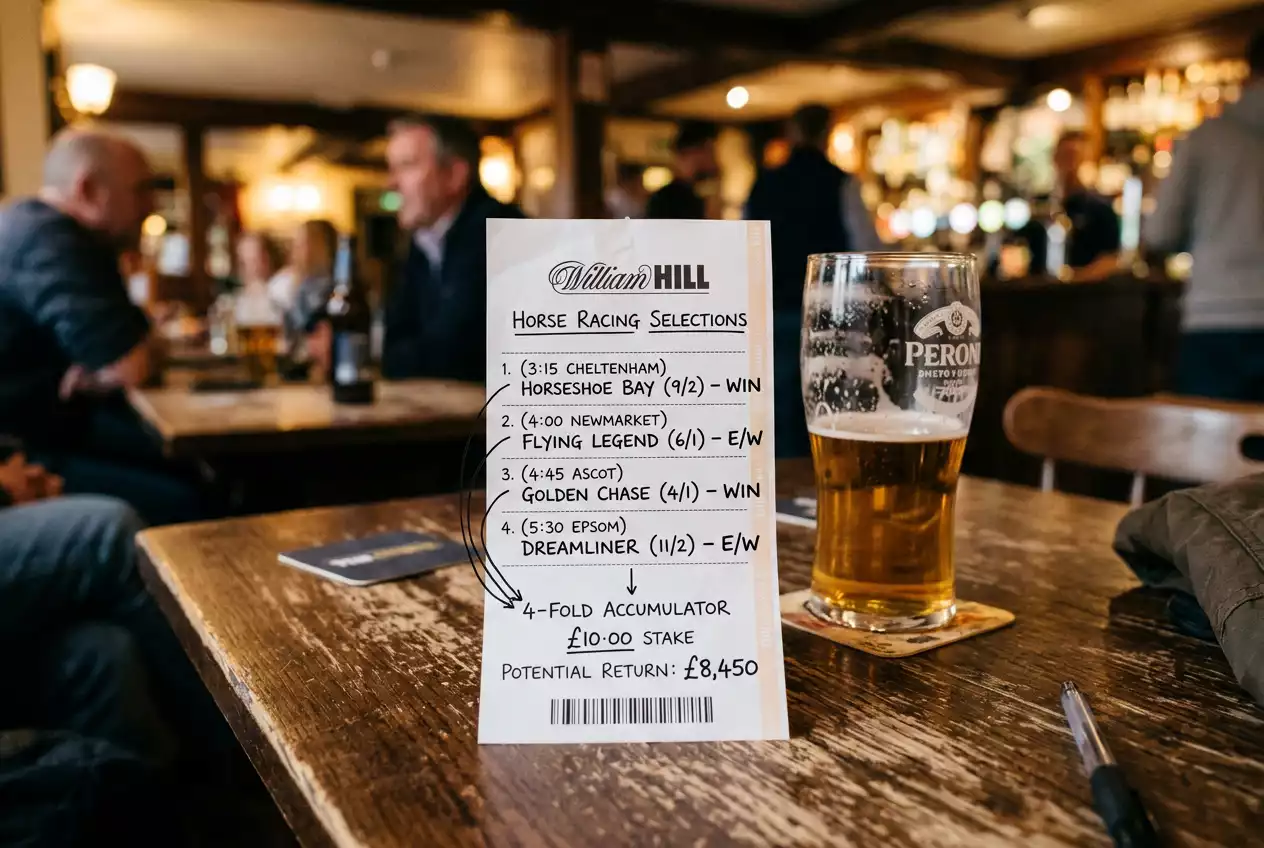
Early prices — sometimes called “morning prices” or “board prices” — are the fixed odds that bookmakers publish from around 10am on the morning of a race. These prices are the bookmaker’s opening assessment of each horse’s chances, adjusted for their own margin and their need to balance the book. By taking an early price, you lock in that number: if the horse opens at 8/1 in the morning and contracts to 5/1 by the off, you still get paid at 8/1.
The flip side is equally true. If the horse opens at 8/1 and drifts to 12/1 by the off because bad news emerges — a poor warm-up, going changes, or a market mover in the race drawing money away — you are stuck with 8/1. This is where Best Odds Guaranteed promotions change the calculus. BOG means the bookmaker will pay you at either your fixed price or the SP, whichever is higher. With BOG, taking the early price removes the downside risk: if the price contracts, you keep the early price; if it drifts, you get the SP. It is a one-way bet in your favour, and it is one of the most valuable promotions in British racing.
Not every bookmaker offers BOG on every race, and the terms vary. Some restrict it to UK and Irish racing. Some cap the maximum payout differential. Some exclude certain race types or meetings. But where BOG is available, the decision becomes simple: take the early price and let the guarantee work for you. The only scenario where SP might still be preferable is when you are betting on a race not covered by BOG — typically overseas meetings or all-weather fixtures at less popular courses.
My own practice is to take morning prices on any horse I have analysed thoroughly, especially when BOG is in play. I log the early price and the eventual SP for every bet, and over a rolling twelve-month sample, the BOG advantage adds roughly 3-5% to my returns compared with what I would have received at SP alone. That margin won’t make headlines, but compounded across hundreds of bets a year, it is a meaningful edge.
How Bookmaker Margins and Overround Shape Your Odds
Every bookmaker market contains a built-in profit margin, and the mechanism through which it operates is called the overround. This is the single most important concept for any punter who wants to understand why odds are what they are — and why the odds on offer are always, without exception, slightly worse than fair.
The overround is the amount by which the sum of all implied probabilities in a market exceeds 100%. In a theoretically fair market — no bookmaker margin — the implied probabilities of all runners would add up to exactly 100%. In a real bookmaker market, they add up to something like 112%, 118%, or even 125% depending on the competitiveness of the race and the bookmaker’s pricing strategy. That excess — the 12%, 18%, or 25% above 100% — is the overround, and it represents the bookmaker’s theoretical margin on the race.
Here is a worked example. Imagine a four-runner race with the following fractional prices: 2/1, 3/1, 5/1, 8/1. Converting to implied probabilities: 2/1 = 33.3%, 3/1 = 25.0%, 5/1 = 16.7%, 8/1 = 11.1%. The total is 86.1%. Wait — that is below 100%, which would mean the bookmaker is offering better than fair odds. That doesn’t happen in practice. A real bookmaker would price this field closer to: 7/4, 5/2, 4/1, 6/1. Converting: 7/4 = 36.4%, 5/2 = 28.6%, 4/1 = 20.0%, 6/1 = 14.3%. Total: 99.3% — still very tight. More realistically, the total might be 110-115%, with the margin spread across all runners.
Where the margin sits matters. Some bookmakers load the margin onto the favourites, keeping the outsiders’ prices close to fair. Others spread it evenly. The net effect is that in a market with a 115% overround, a horse whose true probability of winning is 25% might be priced at odds implying 28-29%, meaning you’re getting paid less than the horse’s actual chance warrants. That gap is the bookmaker’s edge, and it is invisible unless you do the arithmetic.
Competitive pressure between bookmakers keeps overrounds lower than they would otherwise be, particularly on high-profile races with heavy media coverage. A Group 1 at Royal Ascot might trade at 105-108% overround across major bookmakers. A Monday evening novice hurdle at a minor course might trade at 120% or higher. The pattern is consistent: the more money flows into a market, the tighter the overround, because bookmakers compete on price to attract that volume. This is one reason why serious punters concentrate their activity on well-bet races rather than spreading stakes evenly across the card.
The betting exchanges operate differently. Because exchanges match bettors against each other rather than against a bookmaker, there is no overround in the traditional sense. Instead, the exchange charges a commission on net winnings — typically 2-5% depending on the platform and your activity level. The effective margin on exchange markets is almost always lower than the equivalent bookmaker overround, which is why exchange prices tend to be better. The trade-off is liquidity: not every market on an exchange has enough money available to fill your bet at the displayed price, especially in less popular races.
Converting Odds to Implied Probability
Converting odds to implied probability is the gateway to value betting, and the formula is disarmingly simple. For fractional odds of A/B, the implied probability is: B / (A + B) x 100. For decimal odds of D, it is: 1 / D x 100.
So a horse at 5/1 fractional (6.00 decimal) has an implied probability of 1/6 = 16.7%. A horse at 7/4 fractional (2.75 decimal) has an implied probability of 4/11 = 36.4%. These numbers tell you what the market — or more precisely, the bookmaker’s pricing model — believes about each horse’s chances.
The useful part comes when you compare the implied probability with your own assessment. If you think a horse has a 25% chance of winning and the bookmaker’s implied probability is 20%, the odds are offering you value — you are being paid at a rate that assumes the horse is less likely to win than you believe. If the implied probability is 30%, the odds are against you — the bookmaker’s price assumes a higher chance than you credit. This comparison is the foundation of every disciplined betting approach, and it applies regardless of whether you work in fractions or decimals.
A few practical tips. First, remember that implied probabilities derived from bookmaker odds include the overround, so they will overstate the horse’s true chances. To get a “fair” implied probability, you can normalise by dividing each horse’s implied probability by the total overround. Second, implied probability is most useful as a relative tool: comparing your estimate against the market’s estimate for the same horse, rather than taking the implied percentage at face value. Third, if you consistently find that your own probability estimates are well-calibrated over hundreds of bets — that is, horses you rate at 20% actually win about 20% of the time — you have a genuine edge, and the implied-probability comparison will reliably identify where to deploy it.
Why Odds Move: Market Forces and Money Flow
Odds move because money talks. When a significant volume of bets lands on a particular horse, the bookmaker shortens the price to manage their liability — they don’t want to be overexposed if that horse wins. Conversely, when a horse attracts little interest, the price drifts out. This constant adjustment is the racing market’s version of price discovery, and reading it correctly is one of the most valuable skills a punter can develop.
The movement starts early. Overnight markets on the exchanges give the first indication of where money is flowing. Morning prices from the bookmakers follow, usually posted between 9am and 10am. From there, the prices shift through the morning and into the early afternoon as money arrives — from professional punters, syndicates, and the broader public. The pattern is rarely smooth: a horse might open at 8/1, contract to 6/1 by midday on the back of an influential tipster’s recommendation, then drift back to 7/1 as counter-money arrives. By the time the market closes in the final minutes before the off, the price reflects the aggregate opinion of everyone who has put their money where their mouth is.
Betfair, the dominant UK betting exchange, reported a 28% reduction in transaction delays through AI-driven automation in 2025. That kind of speed improvement in exchange infrastructure means price movements happen faster and more efficiently than ever, compressing the window in which stale prices can be exploited. For the average punter, this is a double-edged sword: markets are more informationally efficient, which means the odds are more likely to reflect true probabilities — but it also means that getting on at a favourable price requires quicker reactions or earlier commitment.
Three common patterns to watch for. A steamer is a horse whose price contracts sharply and rapidly — opening at 10/1 and going off at 5/1, for example. Steamers sometimes indicate informed money: stable connections, professional analysts, or exchange syndicates have identified something the public hasn’t. A drifter is the opposite: a horse that opens shorter than it goes off, suggesting that early expectations haven’t been confirmed by the weight of money. Not all steamers win and not all drifters lose, but tracking the direction and velocity of price movement gives you a real-time signal about market confidence.
The third pattern is the late gamble — a horse whose price collapses in the final two or three minutes before the off. Late gambles are the stuff of racing folklore, and they carry an air of insider knowledge. Some are genuine: connections who know their horse is well and the ground is right wait until the last moment to avoid tipping off the market. Others are misleading: money floods in on a rumour or a social-media tip that has no substance. Distinguishing between the two in real time is extremely difficult, which is why I treat late market moves as information to note, not signals to follow blindly.
Across all of this, the underlying message is that odds are not fixed truths — they are opinions, expressed in numbers, that change as new information and new money enter the market. The punter’s job is to form an independent view before the market moves and then use the movement to confirm, challenge, or adjust that view. If you always react to price moves rather than anticipating them, you are trading on yesterday’s information at today’s prices. Turning a price into a probability: value betting.
Frequently Asked Questions
Why do different bookmakers show different odds for the same horse?
Each bookmaker sets their own prices based on their risk models, the money they have taken, and their desired profit margin. A bookmaker who has received heavy bets on one horse will shorten that horse’s price and push out the others to manage liability. Competing firms who haven’t received the same pattern of bets may still show a longer price. This variation is why comparing odds across multiple bookmakers before placing a bet can meaningfully improve your returns.
How is the starting price calculated at UK racecourses?
The starting price is determined by official SP reporters employed by the Starting Price Regulatory Commission. They observe the prices offered by on-course bookmakers in the betting ring immediately before the race starts and record a representative price for each runner. The SP reflects the on-course market at the moment of the off, not the online or exchange markets.
What percentage of the market does the overround typically add?
The overround varies by race type and bookmaker. High-profile races such as Group 1 events at major festivals typically have overrounds of 105-110%, meaning the implied probabilities sum to 105-110% of fair value. Less popular races at smaller meetings may have overrounds of 115-125% or higher. Lower overround means fairer prices for the punter. Betting exchanges generally operate with even lower effective margins because they charge commission on net winnings rather than building margin into the odds.
Is it always better to take early prices rather than wait for SP?
Not always, but in most cases taking the early price is advantageous — especially when Best Odds Guaranteed is available. BOG ensures you receive whichever is higher: your fixed early price or the SP. Without BOG, the decision depends on whether you expect the price to shorten or drift. If you believe a horse will attract late support and the price will contract, locking in the early price secures the bigger number. If you think the horse might drift, waiting for SP could yield a better price, but that involves accepting uncertainty.
Written by the editors at Racing Horse Betting.