
Horse Racing Accumulator Tips: Building Smarter Multiples
 Available in US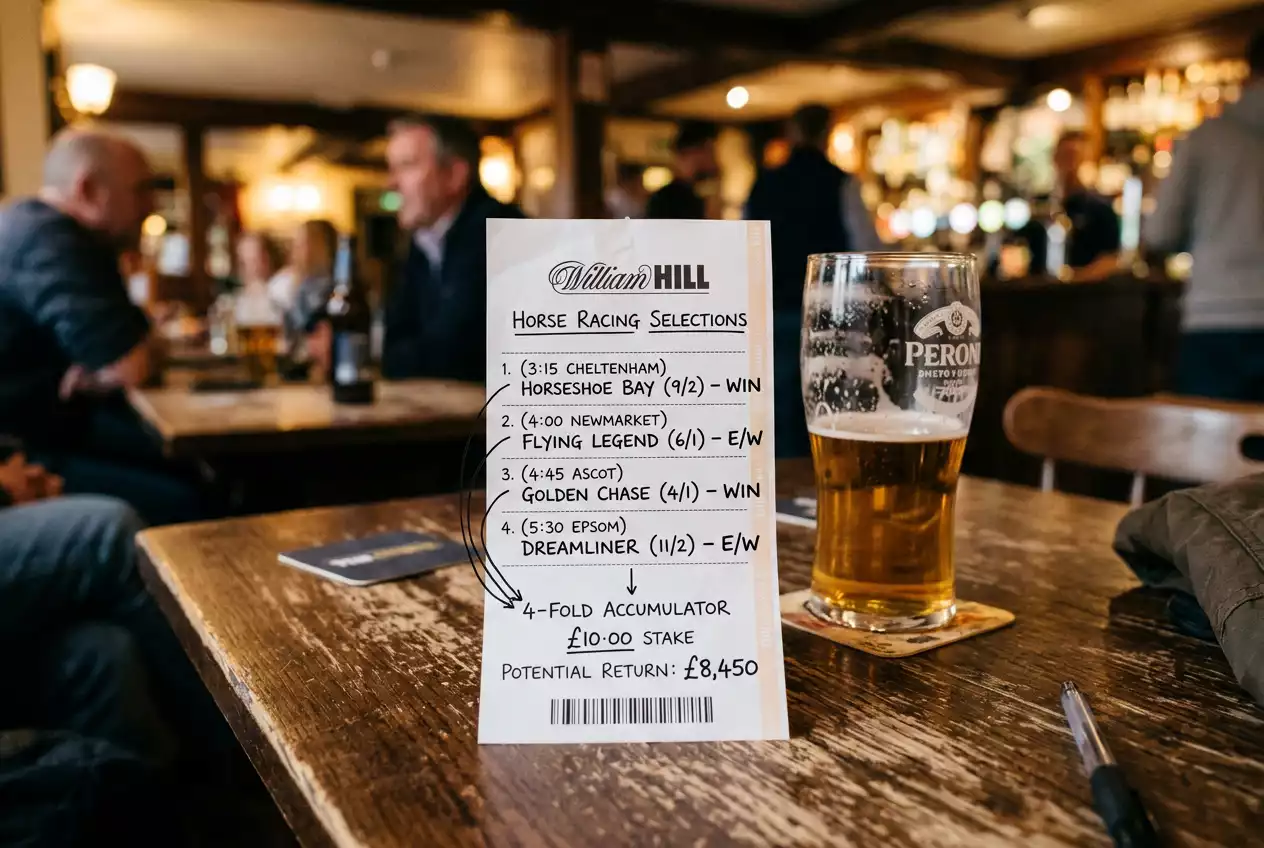
A friend once texted me a screenshot of a six-fold accumulator that would have paid over 4,000 pounds from a two-pound stake. Five legs had won. The sixth — a 4/6 favourite in a five-runner race at Kempton — finished second by a nose. He was gutted. I was not surprised. That is the story of accumulators: electrifying potential, heartbreaking probability. Understanding the maths behind that heartbreak is what separates punters who enjoy accas from punters who depend on them. The full picture is in our guide to UK horse racing betting.
Accumulators — accas, multiples, whatever you call them — chain two or more selections into a single bet where the return from each winning leg rolls into the next. The appeal is obvious: small stakes, huge potential returns. The reality is less glamorous. The bookmaker’s margin compounds with every leg you add, and the probability of all selections winning drops faster than most people intuitively expect.
The Mathematics Behind Accumulator Returns
Let me put some numbers on the table, because this is where the romance of accumulators meets the cold floor of probability. The average turnover per race on core fixtures fell 14.4% in Q1 2025, and part of that decline reflects punters becoming more aware of where their money actually goes — which includes the compounding margin built into multiples.
Suppose you back four horses, each at even money (2.00 in decimal). A four-fold accumulator multiplies the decimal odds together: 2.00 x 2.00 x 2.00 x 2.00 = 16.00. A one-pound stake returns sixteen pounds if all four win. That sounds generous until you consider the true probability. If each horse genuinely has a 50% chance of winning, the probability of all four winning is 0.50 x 0.50 x 0.50 x 0.50 = 6.25%. You will win roughly one in sixteen attempts.
Now add the bookmaker’s margin. In reality, an even-money shot on a standard market does not have a 50% implied probability — it has closer to 52-53% when the overround is factored in. That margin stacks multiplicatively. Across four legs, the combined overround is not four times the single-race margin; it is the product of four individual margins, which grows exponentially. By the time you reach a six-fold, the bookmaker’s edge is substantial — often north of 30% on the true probability of the combined outcome.
This does not mean accumulators are inherently foolish. It means you need to understand what you are paying for. The thrill of a potential big return from a small stake has genuine entertainment value, and there is nothing wrong with that as long as you treat accumulator stakes as entertainment spend rather than an investment strategy.
Selecting Legs: What to Combine and What to Avoid
The quality of an accumulator depends entirely on the quality of each individual leg. I have seen punters spend thirty minutes crafting a four-fold and then add a fifth leg in thirty seconds because “it looks good value”. That casual fifth leg is usually the one that collapses the entire bet.
Combine selections where you have a genuine opinion — a reason beyond “the odds look nice” for believing each horse will win or place. Average field sizes on the Flat dropped to 8.90 in 2025 (down from 9.14 in 2024), and on jumps the figure fell to 7.84. Smaller fields theoretically make individual selections slightly easier, but the odds adjust accordingly, so there is no free lunch. What smaller fields do offer is more predictable form — fewer unknown quantities, more reliable data to base your selections on.
Avoid combining legs that are correlated in ways you cannot control. Backing two horses from the same trainer on the same card might seem clever, but if the trainer’s yard is hit by a virus, both legs fail simultaneously. Similarly, backing two horses that both need soft ground introduces weather-dependent correlation: if conditions dry up, both legs are compromised.
I also avoid mixing high-confidence short-priced selections with speculative long shots. A 1/3 favourite feels like a “banker” leg, but at those odds, it contributes almost nothing to the overall return while carrying the same potential to collapse the entire bet. If you genuinely believe a 1/3 shot is a certainty, back it as a single. Do not dilute its impact by tying it to three other uncertain outcomes.
How Many Legs Should Your Accumulator Have
This is where personal discipline matters more than mathematical optimisation. In theory, the more legs, the bigger the return. In practice, every additional leg multiplies the probability of failure.
Two to four legs is the sweet spot for punters who want a realistic chance of winning. A well-constructed treble (three legs) offers a meaningful return without pushing the probability into lottery territory. At four legs, you are still in a range where, if your strike rate on individual selections is around 35-40%, you might land one in ten or fifteen attempts. Move to five or six legs and the expected hit rate drops to one in thirty or worse — territory where you need a very large number of attempts before the law of averages works in your favour.
The social media highlights showing enormous seven-fold and eight-fold winners are survivorship bias in its purest form. For every screenshot of a 10,000-pound acca landing, there are thousands of identical bets that failed on the second or third leg. You do not see those on social media because nobody photographs a losing slip.
My recommendation: if you enjoy accumulators, keep them to three or four legs. Stake modestly — never more than 1-2% of your monthly betting budget on a single acca. And never increase your stake to “make back” a string of losing multiples. The maths does not support that approach, and the emotional spiral it creates is the fastest route to a bad experience.
Accumulator Insurance and Bonus Offers
Most major UK operators offer some form of accumulator insurance or bonus, and these promotions can meaningfully shift the expected value of a multiple — if you understand the terms.
Acca insurance typically refunds your stake (usually as a free bet, not cash) if one leg of a four-fold or five-fold lets you down. The precise conditions vary: some operators require minimum odds per leg, others specify a minimum number of legs, and the refund is almost always a free bet with its own terms rather than a cash return. Still, getting a second chance on a near-miss four-fold is materially valuable.
Accumulator bonuses add a percentage uplift to your winnings based on the number of legs. A typical structure might offer 5% extra on a three-fold, 10% on a four-fold, 15% on a five-fold, and so on. These bonuses partially offset the compounding margin I described earlier. On a four-fold where the combined return is 20.00, a 10% bonus adds 2.00 to your return — not transformative, but not trivial either.
The smart approach is to let the insurance and bonus terms influence how you construct your acca, not the other way around. If an operator requires minimum odds of 1/5 per leg to qualify for insurance, do not shoehorn in a short-priced selection just to meet the threshold. Build the accumulator you believe in first, then check whether it qualifies for a promotion. The promotion is a bonus, not the strategy. And when you are ready to dig deeper into structured approaches that go beyond accumulators, the principles of value betting and bankroll management become even more relevant. Sizing the stake is half the job: bankroll management.
What is the ideal number of legs for a horse racing accumulator?
Three to four legs offers the best balance between potential returns and realistic probability of winning. At this range, a punter with a solid strike rate on individual selections can expect to land an accumulator roughly once in every ten to fifteen attempts. Beyond five legs, the probability of all selections winning drops sharply, making the bet more of a lottery-style punt.
How does accumulator insurance work at UK bookmakers?
Accumulator insurance refunds your stake — usually as a free bet rather than cash — if one leg of your multiple lets you down. Operators typically require a minimum number of legs and minimum odds per selection to qualify. The refund applies only if exactly one leg fails; if two or more lose, the insurance does not activate. Terms vary between operators, so check before placing.
Written by the editors at Racing Horse Betting.