
NRNB in Horse Racing: What Non-Runner No Bet Means
 Available in US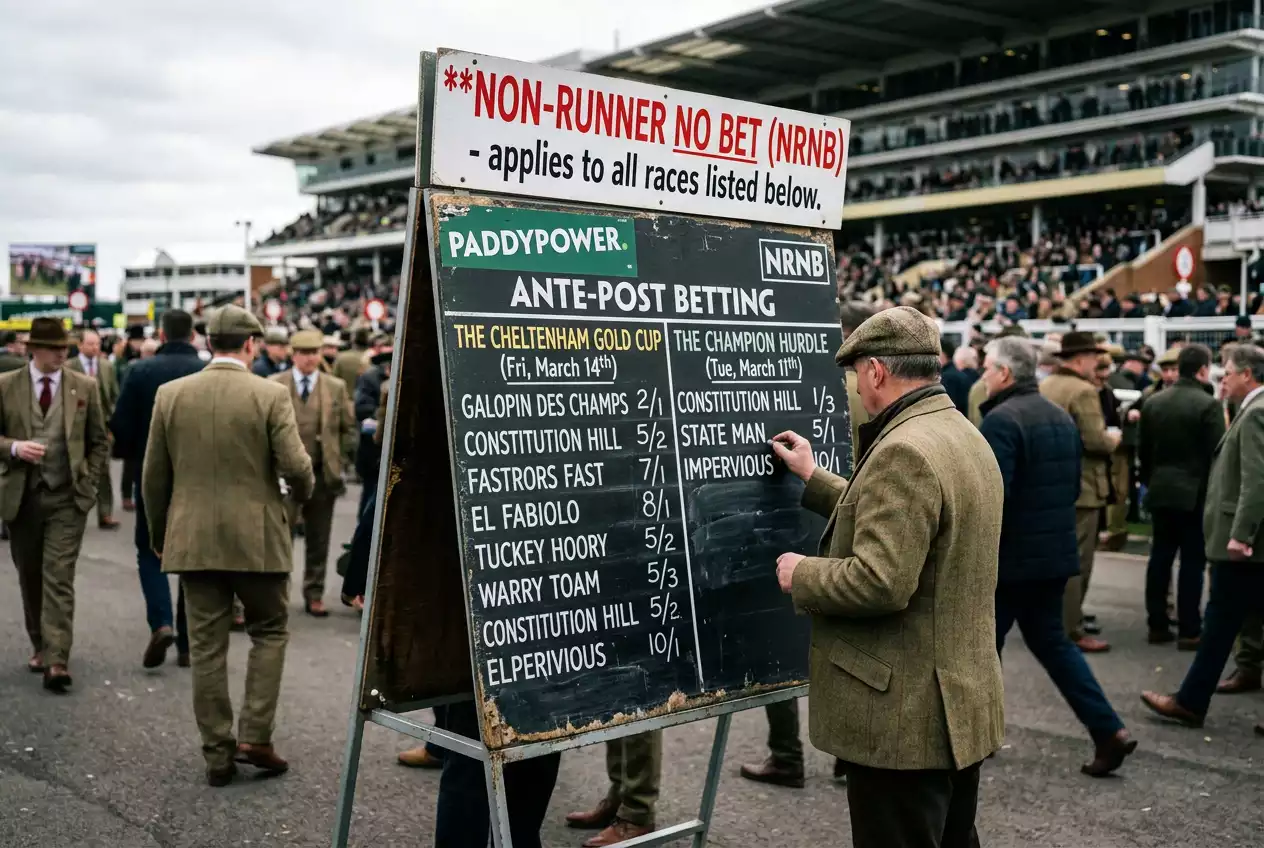
I learned the value of NRNB the hard way. In early 2020, I placed a standard ante-post bet on a Cheltenham Gold Cup hopeful at 16/1 — a horse I had followed all season. Two weeks before the festival, it was ruled out with a tendon injury. No refund, no consolation. A year later, facing a similar situation on a different festival bet, I specifically sought out NRNB markets. The horse was withdrawn ten days before the race, and my entire stake came back. Same scenario, completely different outcome — all because of three letters on the betting slip. The full picture is in our guide to UK horse racing betting.
NRNB — Non-Runner No Bet — is a specific type of ante-post market where the operator guarantees a full refund of your stake if your selected horse does not run. It eliminates the single biggest risk in ante-post betting, and for anyone who has ever lost money on a horse that never made it to the start, it changes the equation fundamentally.
How Non-Runner No Bet Works
The mechanics are straightforward. When an operator opens an NRNB market on a specific race, every bet placed in that market carries an automatic guarantee: if your horse is declared a non-runner for any reason — injury, change of plan, unsuitable conditions, supplementary entry to another race — your stake is refunded in full, usually as cash rather than a free bet.
This is a departure from standard ante-post rules, where non-runners mean lost stakes. The horse population in British training dropped to 21,728 in 2025, continuing a steady decline, and the risk of individual horses not making it to target races has not diminished. Injuries are common. Trainers change plans. Going conditions shift. NRNB removes the financial consequence of all these variables.
The refund is typically processed automatically. You do not need to contact the operator, file a claim, or prove that the horse was withdrawn. The operator monitors declarations and processes refunds when a horse is officially removed from the race. Most refunds appear in your account within 24 hours of the withdrawal being confirmed.
One detail worth noting: NRNB protection applies specifically to the horse not running in the designated race. If your horse is redirected to a different race at the same meeting, your bet on the original race is void and refunded. The bet does not transfer to the new race.
NRNB vs Standard Ante-Post: Key Differences
The trade-off between NRNB and standard ante-post betting comes down to price versus protection. Betting turnover on British racing dropped 9% in Q1 2025 versus the same period in 2024, and as punters become more risk-aware, the appeal of NRNB has grown — but the price you pay for that protection is shorter odds.
In standard ante-post markets, the operator prices in the non-runner risk as part of the odds. You are compensated for the possibility of losing your stake to a withdrawal through bigger prices. A horse might be 14/1 in the standard ante-post market because some of that price reflects the chance it does not run. In an NRNB market on the same race, the same horse might be 10/1 or 8/1 — shorter, because the operator has absorbed the non-runner risk and needs to adjust the price to maintain its margin.
The difference in odds varies by race, by how far in advance the market opens, and by how many runners are still uncertain to participate. Early in the season, when non-runner risk is highest, the gap between standard ante-post and NRNB prices tends to be wider. Closer to race day, as declarations become more certain, the gap narrows because the non-runner risk itself has diminished.
I once compared the same horse across both markets for the Champion Hurdle — 12/1 standard ante-post, 9/1 NRNB. That three-point difference represents the operator’s assessment of the non-runner risk for that particular horse in that particular race. Here is how I think about it: NRNB is insurance. You are paying for that insurance through shorter odds. Whether the insurance is worth the cost depends on your tolerance for losing stakes on non-runners and how frequently your selections are withdrawn. If you back five ante-post selections per season and one is withdrawn, that is a 20% non-runner rate. The NRNB premium needs to be less than 20% of the average price discount to be worthwhile. In my experience, the discount is usually between 15% and 30%, which makes NRNB borderline for experienced punters and clearly worthwhile for those who find non-runner losses emotionally or financially painful.
Which Races and Events Typically Offer NRNB
NRNB markets are not available on every race. Operators choose which events to offer them on, and the pattern is predictable: the bigger and more popular the event, the more likely it is to have an NRNB option.
The Cheltenham Festival is the most prominent NRNB market. Virtually every major operator opens NRNB betting on the Champion Hurdle, the Queen Mother Champion Chase, the Stayers’ Hurdle, the Gold Cup, and several other feature races months before the March festival. The Grand National at Aintree is another staple — NRNB markets for the National typically open from the autumn of the preceding year.
Royal Ascot, the Derby at Epsom, the King George at Kempton, and other prestige flat races attract NRNB markets during the spring and summer. Some operators extend NRNB to the major Irish festivals — Leopardstown at Christmas, Punchestown in the spring — although coverage for Irish racing is less consistent than for British events.
Everyday handicaps and midweek cards almost never feature NRNB. The administrative cost of processing refunds and the thinner margins on lower-profile races make it uneconomical for operators. If you want NRNB protection, your betting is effectively limited to the marquee events on the racing calendar — which, for many punters, are the races they care most about anyway.
Some operators are more generous than others with their NRNB offerings. A few extend it to the full card at major festivals, covering every race across four days rather than just the feature events. Others restrict it to a handful of championship races. Comparing NRNB coverage across your active accounts is worth doing at the start of each season — it costs nothing and can save you from the heartbreak of an unprotected non-runner in a race where another operator would have refunded you. For a broader look at how ante-post risk shapes your betting approach, the full mechanics of ante-post markets put NRNB into its proper strategic context. The market it applies to: ante-post betting.
Do all bookmakers offer NRNB on the same races?
No. Each operator decides independently which races to offer Non-Runner No Bet markets on. Most cover the major championship races at Cheltenham, the Grand National, Royal Ascot, and other prestige events, but the breadth of coverage varies. Some operators offer NRNB across the full card at major festivals while others restrict it to headline races only. Comparing operators before the season starts is worthwhile.
Does NRNB apply to each-way ante-post bets?
In most cases, yes. If an operator offers NRNB on a race and you place an each-way bet, both the win and place parts of your stake are refunded if the horse does not run. However, always check the specific terms — a small number of operators may apply NRNB differently to each-way bets or exclude them from the offer.
Prepared by the Racing Horse Betting editorial staff.