Horse Racing Betting Exchanges: How Back and Lay Markets Work
 Available in US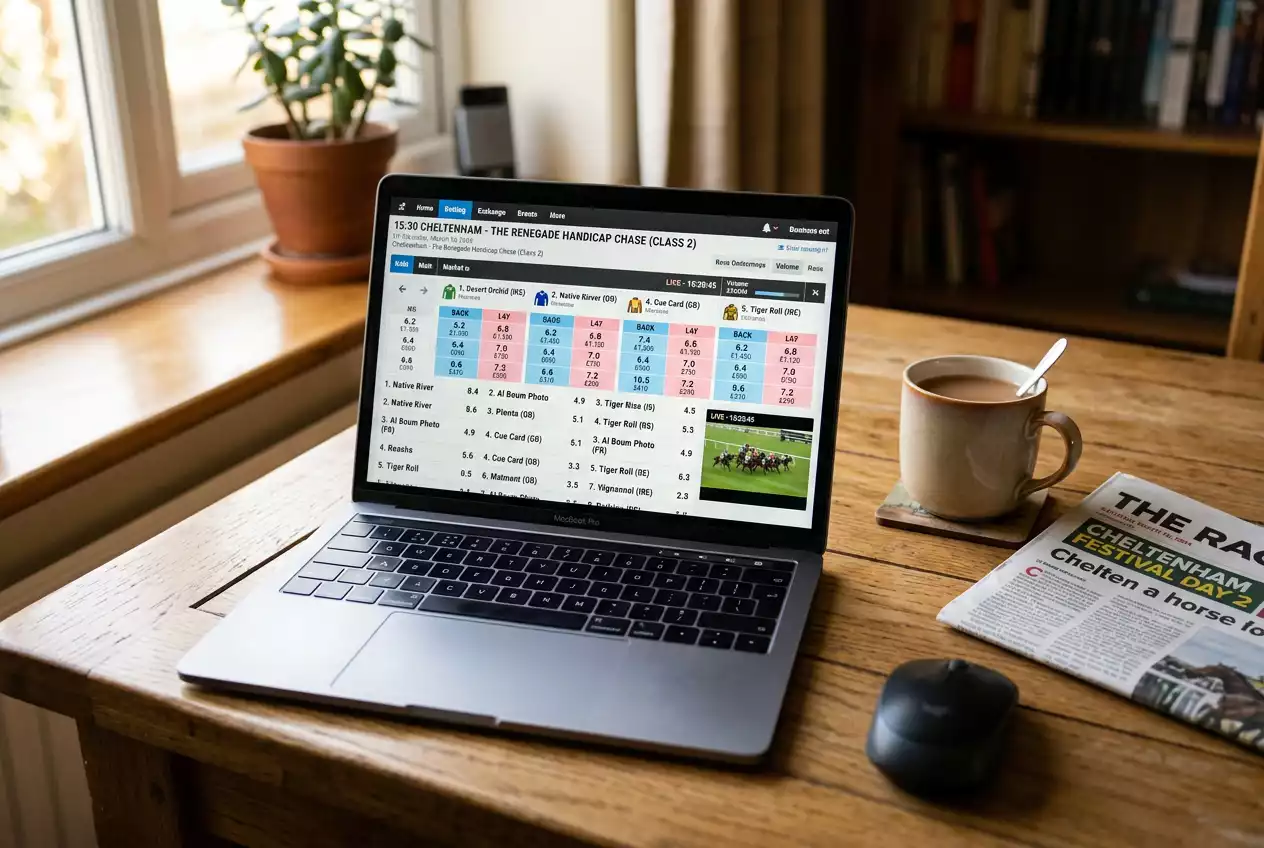
Picture this: you click what you think is a “bet” button, the horse wins, and you owe money instead of collecting it. That was my introduction to betting exchanges — an accidental lay bet on a 3/1 winner that cost me £30 I never intended to risk. I spent the next thirty minutes trying to understand what had just happened. That confusion is more common than the exchange platforms would like to admit, and it underscores the fundamental difference between exchanges and traditional bookmakers: on an exchange, you are not betting against a company — you are betting against other people. The full picture is in our guide to UK horse racing betting.
Online betting has long accounted for the majority of horse racing turnover. An earlier BHA analysis showed that online channels represented around 65% of wagering volume and just over half of gross gambling yield from racing. Within that online space, exchanges occupy a distinctive niche — they strip away the bookmaker’s role as counterparty and replace it with a peer-to-peer marketplace where anyone can offer odds and anyone can take them. The global online horse racing betting market was valued at around £360 million in 2025, with projections pointing toward £504 million by 2033. Exchanges are a growing slice of that landscape, driven by bettors who want better odds, more flexibility, and the ability to trade positions before a race finishes.
This guide covers the mechanics of how exchanges work, the commission structures that replace the bookmaker’s margin, the liquidity dynamics that determine whether you can actually get your bet matched, and the practical applications of lay betting — including when exchanges beat bookmakers and when they don’t.
Table of Contents
- How a Betting Exchange Matches Back and Lay Orders
- Commission Rates and Net Profit Calculation
- Market Liquidity: Why It Matters and When It Runs Thin
- Exchange Odds vs Bookmaker Odds: A Side-by-Side Comparison
- In-Play Trading on Horse Racing Markets
- Practical Uses for Lay Betting in Horse Racing
- Risks, Limitations and Who Exchanges Suit Best
- Frequently Asked Questions
How a Betting Exchange Matches Back and Lay Orders
A betting exchange operates like a stock market for racing opinions. There are two sides to every transaction: backers, who believe a horse will win, and layers, who believe it won’t. The exchange platform matches these opposing views by pairing a back bet at a given price with a lay bet at the same price. When a match occurs, the bet is “matched” and becomes binding. If no match occurs, the bet sits unmatched in the order book until someone takes it or the market closes.
When you back a horse on an exchange, the experience feels similar to placing a bet with a bookmaker. You select a horse, choose your stake, and the odds represent your potential profit if the horse wins. The difference is that the odds haven’t been set by a bookmaker’s pricing algorithm — they have been set by another bettor who is willing to take the other side. This peer-to-peer structure is why exchange odds are typically better than bookmaker odds: there is no margin built in by a corporate entity.
When you lay a horse, you are taking the bookmaker’s role. You are offering odds to someone else, and if the horse wins, you pay out. If the horse loses, you keep the backer’s stake (minus the exchange’s commission). The key number for a layer is the liability — the maximum amount you could lose if the horse wins. Your liability equals the backer’s potential profit. If you lay a horse at 5.00 (4/1 in fractional) for a £10 bet, your liability is £40 — that is the profit the backer would collect if the horse wins, and it comes out of your pocket. If the horse loses, you keep the £10 stake minus commission.
The order book displays the best available back and lay prices for each runner, along with the amount of money available at each price. The gap between the best back price and the best lay price is the “spread” — it is the exchange equivalent of the bookmaker’s margin, except it is created by the market participants rather than by the house. Tight spreads on popular races mean the exchange market is liquid and efficient. Wide spreads on obscure races mean you will pay a larger effective margin to get your bet matched.
Understanding the order book is essential. The displayed back price is the best price currently available for you to back the horse — someone is already offering to lay at that price. The displayed lay price is the best price available for you to lay — someone is already offering to back at that price. If you want a better price than what is displayed, you can submit a request at your preferred odds and wait for someone to match it. This is called “requesting a price” and it is the exchange equivalent of placing a limit order in a stock market. The risk is that your request may never be matched, especially if the market moves away from your price before the race starts.
Commission Rates and Net Profit Calculation
Exchanges don’t build margin into the odds — they charge commission on your net winnings instead. This is the fundamental economic difference between an exchange and a bookmaker, and it is the reason exchange prices are consistently better. But commission is not a flat fee, and understanding how it works changes how you calculate your true return.
The standard commission rate on the dominant UK exchange sits at around 5% of net profits per market, though this varies. High-volume bettors can negotiate lower rates — sometimes as low as 2% — based on their activity levels. Some exchanges offer tiered commission structures where the rate decreases as your cumulative profit or turnover increases. Others offer introductory rates to attract new users, which revert to the standard rate after a qualifying period.
The calculation is straightforward. If you back a horse at 6.00 (5/1) for £10 and it wins, your gross profit is £50. At 5% commission, you pay £2.50 to the exchange, leaving you with a net profit of £47.50 and a total return of £57.50 including your stake. If you lose, you pay no commission — the exchange only takes a cut of winning outcomes. This asymmetry is attractive: you pay nothing on losing bets and a small percentage on winning ones.
For layers, commission works the same way but from the other side. If you lay a horse at 6.00 for £10 and the horse loses, you keep the £10 backer’s stake minus 5% commission on your net profit — so you keep £9.50. If the horse wins, you pay out £50 in liability and the exchange takes no commission because you didn’t profit.
Where the arithmetic gets important is in comparing exchange returns with bookmaker returns after accounting for commission. A horse priced at 5.00 on the exchange with 5% commission delivers a net profit of 3.80 per unit staked (4.00 gross minus 0.20 commission). The equivalent bookmaker price would need to be 4.80 or higher to match that return. In practice, the bookmaker price on the same horse is often 4.50 or 4.00, because the bookmaker’s built-in margin is larger than the exchange’s commission. But in less liquid markets or on short-priced favourites, the gap narrows — and sometimes the bookmaker’s Best Odds Guaranteed promotion makes the fixed-odds route competitive or even superior.
Market Liquidity: Why It Matters and When It Runs Thin
Liquidity is the exchange bettor’s oxygen. It determines whether you can get your bet matched at the price you want, at the size you want, when you want it. A market with deep liquidity — millions of pounds available across multiple price points — lets you place large bets without moving the price. A market with thin liquidity — a few hundred pounds available at the best price — means your bet will either go partially unmatched or move the price against you as you fill it.
Online horse racing turnover has fallen by £1.6 billion since 2022, and that contraction has not bypassed the exchanges. Thinner overall market volumes mean less money in the exchange order book, particularly on mid-week cards and lower-grade races. The liquidity is still robust on Premier Fixtures — a Saturday Group 1 at Ascot or a Cheltenham Festival race will attract hundreds of thousands in matched bets. But a Monday evening novice hurdle at Fontwell might have only a few thousand available, which limits how much you can bet without distorting the market.
Liquidity follows a predictable pattern through the day. Markets for the following day’s racing begin to form in the evening and overnight, with initial prices posted by market-makers and early movers. Volume builds through the morning as more backers and layers enter, and it peaks in the final ten to fifteen minutes before the race. In-play markets see a fresh surge of liquidity once the race is underway, as traders enter and exit positions based on the live action. If you are trying to get a large bet matched at a specific price, the pre-race window is your best opportunity — waiting until the final minutes offers the deepest pool but also the most competition for price.
One practical rule I follow: never assume the displayed price is available for your full stake. The order book shows how much money is waiting at each price point. If the best back price is 6.00 with £500 available and you want to bet £1,000, only half your bet will be matched at 6.00 — the remainder will either go unmatched or fill at the next available price (6.20, 6.40, etc.). Checking the depth of the order book before committing is a habit that prevents slippage.
Exchange Odds vs Bookmaker Odds: A Side-by-Side Comparison
The comparison between exchange odds and bookmaker odds is not as simple as “exchanges are always better.” They usually are — but the margin depends on the race, the horse, and the promotions in play.
On a well-bet Saturday handicap, the exchange back price on a mid-range runner might be 8.00 (7/1), while the best bookmaker price is 7.00 (6/1). After 5% exchange commission, your net exchange return on a winning £10 bet is £66.50, versus £70.00 at the bookmaker. Wait — the bookmaker is better? Not quite. That 7.00 bookmaker price might have Best Odds Guaranteed attached, meaning if the SP drifts to 8.00, you get paid at 8.00 anyway. In that scenario, the bookmaker with BOG genuinely beats the exchange. But if the SP comes in at 6.50, you are stuck with 7.00 at the bookmaker while the exchange price was 8.00 pre-race.
The general rule: exchanges offer the best raw prices most of the time, particularly on outsiders and in markets with active trading. Bookmakers can compete or even win on short-priced favourites (where the exchange spread is tighter and the commission bites harder) and on any race where BOG is in play and the SP drifts above the fixed price. For a deeper look at how odds formats and margins work, including overround calculations, the odds guide covers the mechanics in detail.
One advantage bookmakers hold is simplicity. You see a price, you click, the bet is placed. On an exchange, you need to check the available liquidity, decide whether to take the displayed price or request a better one, monitor whether your bet has been matched, and factor in the commission on any winnings. For casual punters betting small stakes on weekend racing, the convenience of a bookmaker often outweighs the marginal price advantage of the exchange. For serious bettors placing larger stakes across multiple races, the cumulative price advantage of the exchange — even after commission — is significant enough to justify the extra complexity.
In-Play Trading on Horse Racing Markets
In-play trading is where exchanges diverge most dramatically from traditional bookmakers. Once a horse race begins, the exchange market stays open — prices move in real time as the race unfolds, and bettors can enter and exit positions with every stride. A horse leading at halfway might see its exchange price shorten from 4.00 to 1.50; a horse trapped at the back of the field might drift from 6.00 to 50.00 in the space of a furlong. The volatility is extreme, and it creates opportunities for traders who can read a race as it happens.
Betfair achieved a 28% reduction in transaction delays through AI-driven automation of its settlement processes in 2025. That kind of speed improvement matters in in-play markets where fractions of a second can determine whether your trade is matched at the intended price or at a worse one. The exchange infrastructure has become significantly faster and more reliable, which has attracted a growing cohort of in-play specialists — many of them using algorithmic trading tools to execute their strategies.
The most common in-play trading strategy in horse racing is “green book” trading: backing a horse before the race at a higher price and then laying it in-play at a shorter price once it is travelling well. The difference between the two prices, adjusted for stakes and commission, is the trader’s profit — regardless of whether the horse ultimately wins. This is the exchange equivalent of buying low and selling high. It sounds elegant, and when it works, it is. But the risks are substantial: if the horse stumbles, falls, or gets boxed in before you can close your position, the price reverses violently and your planned profit becomes a real loss.
In-play trading requires a live video feed with minimal delay, fast internet, and a deep understanding of race dynamics. It is not a beginner’s game. I traded in-play for two years before accepting that my skill level didn’t justify the stress and the risk, and I moved my activity back to pre-race markets where I had a clearer edge. That is an honest assessment, and I think more punters would benefit from making the same one. In-play trading is profitable for a small minority of highly skilled, well-equipped practitioners. For most bettors, the pre-race exchange market offers better risk-adjusted opportunities.
Practical Uses for Lay Betting in Horse Racing
Nevin Truesdale, former CEO of The Jockey Club, once remarked that the Gambling Commission seemed to want to reduce gambling to just small-stakes gamblers — a perspective that reflects the tension between regulatory caution and the reality that many serious punters use sophisticated tools like lay betting to manage their risk, not to gamble recklessly.
Lay betting has several practical applications beyond simply opposing a horse. The most common is hedging. If you have backed a horse ante-post at 10.00 and the price has shortened to 5.00 on race day, you can lay the horse on the exchange to lock in a guaranteed profit regardless of the result. The maths: you backed for £10 at 10.00, giving you a potential profit of £90. You now lay £18 at 5.00, giving you a liability of £72 if the horse wins but collecting £18 if it loses. If the horse wins, your net position is £90 (back profit) minus £72 (lay liability) = £18 profit, minus commission. If the horse loses, your net position is -£10 (back loss) plus £18 (lay gain) = £8 profit, minus commission. Either way, you profit. The size of the guaranteed profit depends on how much the price has moved and how you structure the lay stake.
Another use is opposing short-priced favourites. If you believe a favourite is overbet and its true probability is lower than the market implies, laying it at short odds gives you a high-probability small profit. A horse at 2.00 (evens) that you lay for £50 exposes you to £50 in liability if it wins, but returns £50 minus commission if it loses. If you believe the horse has a 40% chance of winning rather than the 50% implied by the odds, laying it is a value bet in reverse.
A third application is dutching via the lay side. Instead of backing three horses you like, you lay the horses you don’t like. In a six-runner race, if you think three horses have no realistic chance, laying those three for small stakes can produce a profit if any of your three preferred runners wins. The combined liability across the three lays needs to be manageable, and the prices need to be long enough that the lay stakes are modest relative to the potential return.
Lay betting is a tool of precision, not speculation. Every lay position has a defined liability, and managing that liability — knowing exactly how much you stand to lose if the horse wins — is the non-negotiable discipline. Punters who lay without calculating their liability in advance are the ones who get into trouble.
Risks, Limitations and Who Exchanges Suit Best
Exchanges are not for everyone, and pretending otherwise would be dishonest. The learning curve is steeper than with a bookmaker. The interface is more complex. The risk of error — laying when you meant to back, requesting a price that gets matched at an inopportune moment, forgetting about unmatched bets — is real. I have made all of these mistakes, and each one cost me money.
Liquidity constraints are the most practical limitation. If you bet in small stakes on well-covered races, you will rarely encounter liquidity problems. But if you want to place £500 on a horse in a Monday novice hurdle, the exchange may not have enough money available at the displayed price. You either accept worse odds or leave the bet partially unmatched. Bookmakers, for all their margin disadvantages, will usually accept a bet at the displayed price up to a liability limit — no order book to worry about.
Tax treatment is another consideration. Under current UK rules, bettors do not pay tax on their winnings — the operators absorb the duty. Exchange commission is not classified as tax, but it functions similarly in reducing your net return. The effective cost of exchange betting (commission on net profits) versus bookmaker betting (margin built into odds) depends on your win rate: frequent winners pay more in cumulative commission, while frequent losers pay less because commission only applies to profitable outcomes.
Exchanges suit a specific type of bettor: someone who values price above convenience, who is comfortable with a more complex interface, who bets frequently enough that the cumulative price advantage outweighs the learning costs, and who has the discipline to manage lay liabilities and monitor unmatched bets. For casual punters who bet on the Grand National and a few Saturday afternoons a year, a bookmaker with Best Odds Guaranteed is simpler, faster, and often competitive on price. For active punters who bet multiple times per week and treat racing as a serious analytical pursuit, the exchange is an essential tool — not a replacement for bookmakers, but a complement that opens up strategies and price levels unavailable in the fixed-odds world. Exchange prices are decimal: how odds formats work.
Frequently Asked Questions
How do betting exchanges differ from traditional bookmakers?
A bookmaker sets the odds and takes the opposite side of every bet you place, building a profit margin into the prices. A betting exchange connects backers and layers — individual bettors on opposite sides of the same outcome — and charges a commission on net winnings instead. Exchange odds are typically better because there is no corporate margin, but liquidity can be limited on less popular races, and the interface is more complex.
What happens if my lay bet is unmatched before the race starts?
An unmatched lay bet is cancelled automatically when the market closes at the start of the race. You will not owe any money and no liability is triggered. However, if the bet is partially matched, the matched portion remains active and the unmatched portion is voided. Always check your open bets before a race to confirm what has been matched and what remains outstanding.
Do I pay commission on losing exchange bets?
No. Exchange commission is charged only on net winnings per market. If you lose a bet, you pay no commission on that outcome. Commission is calculated on your net profit across all bets in a single market — so if you have both winning and losing positions on the same race, the commission applies to the net gain, not the gross.
Can I use betting exchanges for ante-post horse racing markets?
Yes. Most exchanges offer ante-post markets on major races and festivals, sometimes months in advance. Liquidity in ante-post exchange markets is typically much thinner than in day-of-race markets, so getting large bets matched at your preferred price may be difficult. Exchange ante-post bets follow standard ante-post rules unless otherwise stated — if your horse does not run, the bet stands and you lose your stake (or collect on your lay if you laid the horse).
Created by the ”Racing Horse Betting” editorial team.