Horse Racing Betting for Beginners: Your First Bet in the UK
 Available in US
My first horse racing bet was a disaster — and I mean that in the most educational way possible. I walked into a betting shop on Cheltenham Gold Cup day in 2017, pointed at a name I liked, handed over a tenner, and watched the horse trail in last by about forty lengths. I had no idea what I was doing. Nine years later, I analyse racing markets for a living, and that clueless tenner remains the best money I ever spent because it got me hooked on understanding how this whole thing actually works. The full picture is in our guide to UK horse racing betting.
If you are reading this, you are probably where I was back then — interested in horse racing betting but unsure where to start. Good news: the barrier to entry is genuinely low. Around 7% of UK adults place a bet on horse racing during peak season, and roughly 68% of racegoers in 2025 were casual visitors or first-timers. You are far from alone. This guide walks you through the essentials — setting up an account, placing your first bet, making sense of odds, and keeping it all under control from day one.
Setting Up Your First Betting Account
I remember staring at a registration form for a solid ten minutes, worried I would somehow do it wrong. In reality, opening a betting account with a UK-licensed operator takes about five minutes and follows the same pattern everywhere. You will need an email address, a UK address, your date of birth, and a form of ID. Every legal bookmaker operating in Britain holds a licence from the UK Gambling Commission, so the verification process is a regulatory requirement, not optional bureaucracy.
Here is what to expect. You pick an operator, fill in personal details, and verify your identity — usually by uploading a photo of your driving licence or passport. Some operators verify instantly through electronic checks; others ask for a document scan. Once verified, you deposit funds via debit card, bank transfer, or an e-wallet. Credit card deposits have been banned in the UK since April 2020, so do not bother trying.
One thing I wish someone had told me early: open your account a day or two before you plan to bet. Verification delays happen, and there is nothing more frustrating than trying to back a horse ten minutes before a race only to find your account is still “pending review”. Get the admin out of the way when there is no pressure.
Before depositing, set a deposit limit. Every licensed operator is required to offer this. If you decide your monthly budget is fifty pounds, lock that in immediately. You can always adjust it upward later — but the operator must impose a cooling-off period before an increase takes effect, which is exactly the kind of friction that keeps things sensible.
Placing Your First Horse Racing Bet Step by Step
The afternoon of my first proper bet — the one where I actually knew what I was doing — I spent twenty minutes just navigating the interface. Modern betting apps are far more intuitive now, but the core process has not changed. Let me walk you through it.
First, pick a race. On any given day during the season, there will be meetings at several UK courses. Each meeting has a card — a list of races, each with a scheduled time, a distance, and a set of declared runners. You do not need to analyse form for your first bet; just pick a race and look at the runners.
Second, choose a horse. Tap or click its name, and it drops into your bet slip — a small panel (usually at the bottom of your screen on mobile) showing your selection. You will see the current odds displayed next to the horse’s name, either as a fraction like 5/1 or a decimal like 6.00.
Third, enter your stake. This is how much you want to risk. Type in your amount — say, two pounds — and the slip will instantly calculate your potential return. At odds of 5/1, a two-pound win bet returns twelve pounds if the horse wins: ten pounds profit plus your two-pound stake back.
Fourth, confirm the bet. Once you press “Place Bet”, the wager is live. Some operators offer a “confirm bet” toggle you can switch on if you want an extra safety step.
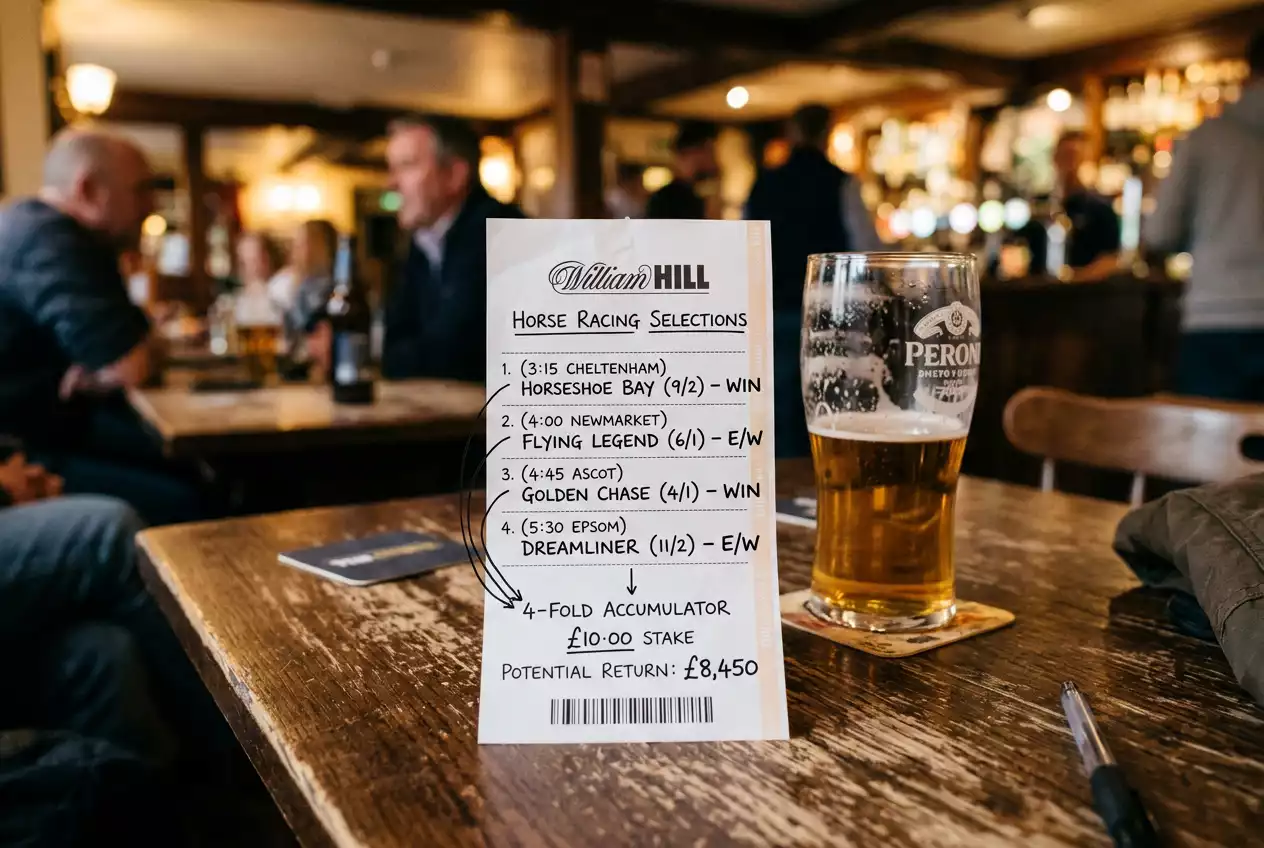
For your first bet, I would suggest sticking to a simple win bet — you are backing one horse to finish first. Once you are comfortable, you can explore each-way bets, forecasts, and accumulators, but there is no rush. A win bet is the cleanest way to learn because the outcome is binary: the horse wins, or it does not.
One practical detail that catches people out: odds can change right up until the race starts. The price you see when you add a selection to your slip might shift by the time you confirm. Most operators let you choose between taking the current price (locking it in) or accepting Starting Price (SP), which is the final price determined at the moment the race begins. For a first bet, taking the price shown on screen is the simplest approach.
Understanding Odds at a Glance
Odds baffled me for weeks. Not the maths — the maths is straightforward — but the fact that UK racing uses fractional odds while almost every other sport I followed used decimals. Here is the shortcut I wish I had been given.
Fractional odds tell you the profit relative to your stake. At 4/1, you win four pounds for every one pound staked. At 11/2, you win eleven pounds for every two pounds staked (or five pounds fifty for a one-pound bet). The horse with the shortest odds — say, 2/1 versus 10/1 — is the one the market considers most likely to win. It does not mean the horse will win; it means more money has been wagered on that outcome.
Decimal odds roll your stake into the number. A horse at 5.00 returns five pounds total for every one pound staked — that is four pounds profit plus one pound stake. A horse at 2.00 returns two pounds total: one pound profit plus your stake. To convert fractional to decimal, divide the first number by the second and add one. So 5/2 becomes (5 / 2) + 1 = 3.50.
The favourite is the horse with the lowest odds. In a typical race, the favourite wins roughly 30-35% of the time — which means it loses about two-thirds of the time. That single stat reshaped how I thought about betting. The market favourite is a useful indicator, but it is not a cheat code.
If you prefer decimals, every UK betting site lets you switch format in the settings. I analyse in decimals and display in fractional when writing for a British audience, because that is the traditional format here. Use whichever feels natural to you.
Setting Limits From Day One
I have been around this industry long enough to have seen talented analysts blow through their bankrolls because they never set boundaries. Horse racing betting should be entertainment with an analytical edge, not a second mortgage. Here is how I approach it, and how I recommend beginners start.
Decide on a monthly budget before you open your account — not after your first loss. This should be money you can genuinely afford to lose without it affecting your rent, bills, or quality of life. For most beginners, somewhere between twenty and fifty pounds a month is plenty to learn with. Set that as your deposit limit in the operator’s responsible gambling tools.
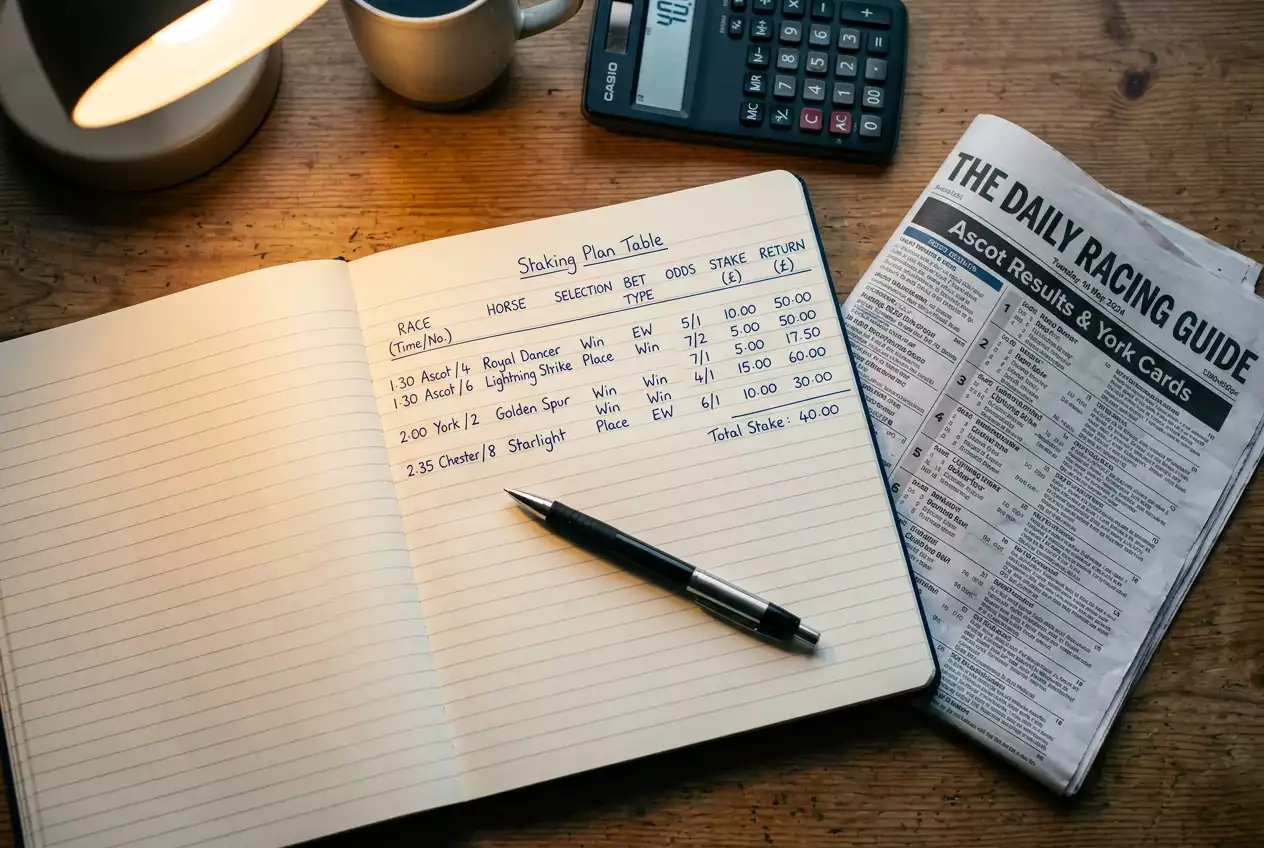
Track every bet. It sounds tedious, but a simple spreadsheet — date, race, horse, stake, odds, outcome — transforms your betting from a series of isolated punts into a dataset you can learn from. After a month, you will spot patterns: maybe you consistently overstake on favourites, or your each-way bets on big fields are where you find value. Data reveals what instinct hides.
Never chase a loss. This is the oldest advice in gambling and the hardest to follow. If you lose your first three bets and feel the urge to double up on the fourth to “get even”, close the app. The horse does not know you need it to win. The race does not care about your balance sheet. Walk away, come back tomorrow with a clear head, and bet your normal stake.
The UK Gambling Commission’s surveys consistently show that around 27% of the adult population participates in gambling beyond the National Lottery. Horse racing sits within that broader ecosystem, and the regulatory framework exists specifically to keep it safe. Use the tools your operator provides — deposit limits, session reminders, cooling-off periods, self-exclusion if needed. They are not signs of weakness; they are features designed by people who understand the psychology of wagering.
Starting out in horse racing betting is one of the most rewarding ways to engage with the sport. The first time you study a form guide, notice something the market has missed, and watch your horse come home — that is a feeling that no amount of passive spectating can replicate. Keep it controlled, keep learning, and the rest follows. Your next step is understanding the bet types.
How much money do I need to start betting on horse racing?
You can start with as little as one or two pounds. Most UK bookmakers have no minimum deposit above five pounds, and minimum stakes are typically as low as ten pence for online bets. A monthly budget of twenty to fifty pounds is enough to learn the fundamentals without meaningful financial risk.
Can I bet on horse racing with my mobile phone?
Yes. Every major UK-licensed bookmaker offers a mobile app or a fully responsive website. You can open an account, deposit funds, place bets, and watch live streams directly from your phone. Mobile now accounts for the majority of online horse racing wagers in Britain.
Written by the editors at Racing Horse Betting.